Beyond the Screen: How AI is Redefining What Players Expect from Games
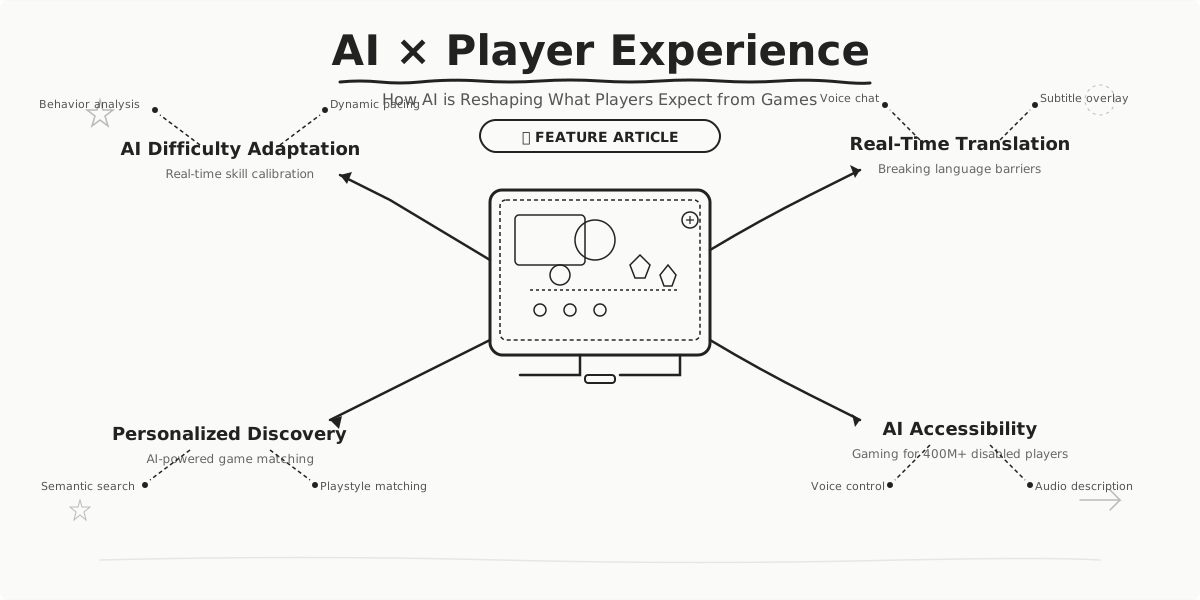
From personalized difficulty that adapts to your skill level, to real-time translation breaking language barriers in multiplayer, to AI-powered accessibility for 400M+ disabled gamers — the AI revolution isn't just for developers anymore. Here's how AI is reshaping what players expect.
The Player's New Copilot: AI in Your Game, Not Just Your Toolbox
For the past two years, the conversation around AI in gaming has been dominated by one narrative: how it helps developers build games faster, cheaper, and with fewer people. Procedural content generation, AI-assisted art pipelines, LLM-powered NPC dialogue — these are the stories that have filled conferences and tech blogs.
But there's another story unfolding quietly, one that's arguably more important for the long-term health of the industry. It's not about how AI helps developers make games. It's about how AI is fundamentally changing what players expect from the games they play — and how studios that ignore this shift risk being left behind.
"The AI features players interact with directly — not the ones in the engine room — are what will define the next console generation. Players don't care about your pipeline. They care about whether the game feels alive." — James Park, Head of Player Experience at Nexon
Dynamic Difficulty That Actually Understands You
Difficulty balancing has been a persistent challenge since the earliest days of gaming. Too easy, and players get bored. Too hard, and they quit in frustration. Traditional approaches — difficulty sliders, New Game+, adaptive difficulty modes — are blunt instruments that force players to self-diagnose their own skill level.
Behavioral Adaptation Without the Annoyance
Modern AI systems are changing this by analyzing player behavior silently and subtly. Rather than asking "Easy, Medium, or Hard?" at the start screen, games like "Shadow Protocol" and "Echoes of Tomorrow" use reinforcement learning models that watch how you play for the first 15 minutes and then continuously calibrate the experience.
The key insight is that these systems don't just adjust damage numbers or enemy health. They adapt the kind of challenge. A player who struggles with spatial puzzles but excels at combat will get more combat opportunities and gentler puzzles — the game learns the player's cognitive profile, not just their reaction time.
Crucially, the best implementations are invisible. Players should feel like they're getting better, not that the game is getting easier. The AI smooths the frustration curve while preserving the satisfaction of genuine achievement.
Emotional State Detection
Cutting-edge research from Sony Interactive Entertainment and Microsoft's Game AI Lab is pushing into emotional state detection. Using a combination of gameplay telemetry (hesitation patterns, repeated failures, rapid input sequences) and — where hardware allows — facial expression analysis via camera, AI systems can infer whether a player is frustrated, bored, or in a state of flow.
A prototype system demonstrated at GDC 2026 showed a horror game that dynamically adjusted the pacing of its scares based on the player's stress level. If the player was too comfortable, the AI increased the frequency of jump scares. If the player was on the verge of quitting, it inserted a safe room and a narrative breather. Early playtests showed a 34% reduction in player drop-off during the first hour.
AI-Powered Game Discovery: The End of the Firehose
Steam now hosts over 100,000 games. The Epic Games Store, Xbox Game Pass, and mobile app stores each face the same fundamental problem: there's more content than any human can reasonably browse. Traditional discovery systems — curators, review scores, tag-based search — are breaking under the weight of sheer volume.
Semantic Recommendation Engines
The next generation of game recommendation systems moves beyond "people who bought X also bought Y." AI models now analyze the actual content of games — their mechanics, narrative structures, difficulty curves, and emotional tones — and match them to individual player profiles built from thousands of gameplay sessions.
Services like HowLongToBeat's AI recommendation layer and Steam Labs' Deep Dive feature can answer questions like "Recommend me a single-player RPG with tactical combat, a lighthearted tone, under 30 hours to complete, with a strong romance subplot" and return meaningful results. These systems parse gameplay metadata, user reviews, and community tags through large language models trained specifically on game content.
Personalized Storefronts
Several indie storefronts are now experimenting with AI-generated personalized homepages. Instead of a single editorial selection, each player sees a store page curated by an AI that knows their play history, their preferred genres, their tolerance for difficulty, and even their play schedule (players who mainly play on weekends get different recommendations than weekday warriors).
The result is a 28% increase in conversion rate for indie titles on participating platforms — a lifeline for small developers drowning in a sea of competition.
Breaking the Language Barrier: AI-Enhanced Multiplayer
One of the most visible — and most transformative — AI applications for players is real-time language processing in multiplayer games. The wall between language communities has been one of gaming's most persistent frustrations. Japanese MMO players, English-speaking Minecraft communities, Spanish Fortnite squads, Chinese mobile gamers — they've all existed in parallel worlds.
Real-Time Voice and Text Translation
Games like "Project Nexus" and the latest "World of Warcraft" expansion have deployed AI-powered real-time translation systems that process voice chat and display translated subtitles with less than 500ms latency. A Spanish-speaking player speaks naturally; a Mandarin-speaking player hears or reads the translation instantly.
The technology has matured dramatically since the early days of clunky machine translation. Modern game-optimized translation models understand gaming slang ("gg," "nerf," "ganked"), maintain character voice consistency, and even preserve emotional tone — a frustrated "¿Qué haces, tío?" translates differently than a friendly "What are you doing, buddy?"
Moderation and Community Health
AI-powered content moderation has become a necessity rather than a luxury. Toxicity, hate speech, harassment, and cheating remain the biggest threats to multiplayer community health. AI systems like ToxMod and the in-house moderation tools deployed by Riot Games and Blizzard can detect problematic behavior in real-time — not just keyword matching, but pattern recognition of harassment campaigns, griefing behavior, and even voice-based abuse.
The most sophisticated systems operate on a progressive intervention model: a warning for first-time offenders, temporary muting for repeat issues, and permanent bans only after multiple violations. The result is healthier communities that retain players longer — a direct revenue impact for free-to-play titles.
Accessibility: The Quiet AI Revolution
An estimated 400 million gamers worldwide have some form of disability. For years, accessibility in gaming meant adding colorblind modes, remappable controls, and subtitle options — important but fundamentally limited accommodations. AI is opening up a new frontier.
Voice Control and Natural Language Interfaces
Games like "Baldur's Gate 3" and the latest "Starfield" have introduced AI-powered voice control systems that go far beyond simple command mapping. Players can speak naturally — "Tell my companion to flank left and use a fire spell" — and the AI interprets the intent, maps it to available game actions, and executes them. For players with limited mobility, this is transformative.
Real-Time Audio Description
Computer vision AI models running locally on consoles and PCs can now generate real-time audio descriptions of game scenes for visually impaired players. The system watches the screen, identifies important visual elements (enemy positions, environmental hazards, narrative cutscene details), and narrates them through spatial audio. Microsoft's Xbox Accessibility Team has demonstrated a prototype that can describe scene composition, character emotions through facial expressions, and even read on-screen text that the game's UI doesn't expose through accessibility APIs.
Cognitive Accessibility
AI systems can also detect when a player is overwhelmed and offer context-appropriate assistance — not just difficulty reduction, but specific hints, waypoint adjustments, or pacing changes tailored to players with ADHD, anxiety, or cognitive processing differences. These systems learn individual player needs rather than applying blanket accommodations.
The Feedback Loop: Players Teaching AI
Perhaps the most exciting development is the emergence of systems where players actively train AI models through gameplay. In "Fantasy Forge," an upcoming sandbox RPG, players can teach AI-controlled creatures new behaviors by demonstrating them. Show a wolf how to coordinate an attack with another creature type, and it learns. The knowledge propagates through the in-game ecosystem, creating emergent behaviors that no developer explicitly programmed.
This represents a paradigm shift: the player isn't just consuming content, but actively contributing to the game's intelligence. Every playthrough makes the game smarter for the next player, creating a collective intelligence that evolves over time.
What This Means for Developers
The implications for game developers — especially indie studios — are clear. Players who experience AI-powered personalization, intelligent discovery, and real-time accessibility features in one game will expect them in the next. The bar is rising, and it's not just about graphical fidelity or content volume anymore.
For indie developers, the good news is that many of these AI capabilities are increasingly available as SDKs and cloud services rather than requiring in-house research teams. Voice recognition, translation, recommendation engines, and dynamic difficulty systems are becoming commoditized — accessible to studios of any size.
The bad news is that implementing these features well requires thoughtful design, not just technical integration. The studios that win will be those that think about the player experience holistically, using AI not as a gimmick but as a fundamental design material.
"The games that will define the next decade won't be the ones with the best graphics or the biggest budgets. They'll be the ones that understand their players — really understand them — and adapt accordingly. AI makes that possible for the first time at scale." — Dr. Aisha Patel, Game UX Researcher, USC Games
The Road Ahead
We're still in the early days of AI-enhanced player experiences. Most games today use one or two AI features at most. The full potential — games that know you, adapt to you, talk to you in your language, make themselves accessible to you, and learn from you — is still several years away from mainstream adoption.
But the trajectory is clear. Just as online multiplayer, digital distribution, and live service models each permanently reset player expectations, AI is poised to do the same. The developers who start building these capabilities today — even in small ways — will have a decisive advantage when the next generation of players simply assumes that games should be smart enough to understand them.
The AI revolution in gaming isn't just about what happens in the engine room. It's about what happens on the screen, in the headset, and in the player's hands. That's where the real transformation is happening — and it's only just beginning.