The Complete Guide to AI Video Generation in 2026: Text-to-Video Tools Explained
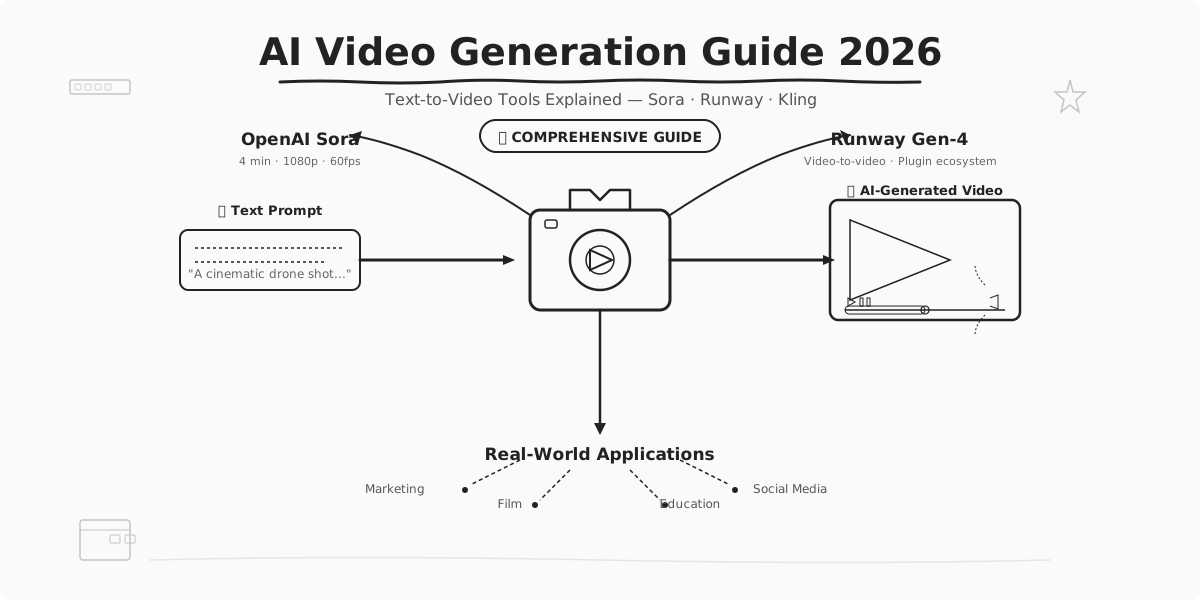
From OpenAI Sora to Runway Gen-4 and Kling 2.0, AI video generation has matured into a practical tool for professionals. This comprehensive guide covers the leading platforms, real-world applications across marketing, film, and education, ethical considerations, and tips for getting started with text-to-video tools in 2026.
The Dawn of AI Video Generation: How Text-to-Video Is Reshaping Content Creation in 2026
When OpenAI unveiled Sora in early 2024, it felt like science fiction. Two years later, AI video generation has evolved from a promising demo into a full-fledged creative tool that is fundamentally reshaping how video content is produced, from Hollywood pre-visualization to social media marketing. The technology has matured so rapidly that in 2026, the question is no longer "can AI make good videos?" but "how do professionals integrate AI video into their workflow?"
This comprehensive guide explores the state of AI video generation in 2026, the leading tools, their real-world applications, and what the future holds for a technology that is democratizing video creation at an unprecedented scale.
"The video generation revolution of 2026 is not about replacing human creators — it's about removing technical barriers and letting anyone with a vision create professional-quality video content. The camera operator becomes a prompt engineer." — Maria Santos, Director of Creative AI at ContentCore Studios
The Leading AI Video Generation Tools of 2026
OpenAI Sora: The Gold Standard
OpenAI's Sora has maintained its position as the most capable text-to-video model in 2026. The latest version, Sora Turbo 3.0, can generate up to 4 minutes of 1080p video at 60fps with remarkable consistency. What sets Sora apart is its understanding of physics and causality — objects in Sora-generated videos behave realistically, shadows track properly, and water flows naturally. For filmmakers, Sora has become an indispensable pre-visualization tool, reducing the time needed to storyboard a scene from days to minutes.
The key improvement in 2026 has been character consistency. Earlier versions struggled to maintain a character's appearance across multiple shots, but Sora now supports character reference sheets — upload a character design, and Sora maintains that character's look, clothing, and proportions across an entire generated sequence.
Runway Gen-4: The Professional's Choice
Runway's Gen-4 model has become the go-to tool for professional video editors and motion designers. Unlike Sora's pure text-to-video approach, Gen-4 excels at video-to-video transformations. Editors can shoot real footage, apply AI-generated style transfers, change backgrounds, or even replace actors — all with frame-accurate control. The green screen, long a staple of video production, is rapidly becoming obsolete.
Gen-4's key differentiator is its integration with traditional editing workflows. The model can be used directly inside Premiere Pro, DaVinci Resolve, and Final Cut Pro through Runway's plugin ecosystem. A video editor can select a clip, type "convert this to a cyberpunk anime style," and see results in under 30 seconds.
Kling 2.0: China's Contender
Kuaishou's Kling model, now in version 2.0, has emerged as a strong competitor from the Chinese AI ecosystem. Kling 2.0 excels at generating high-motion sequences — action scenes, sports, dance — that other models often struggle with. Its physics simulation for cloth, hair, and particle effects is arguably the best in the industry. For marketing videos and product demonstrations, Kling 2.0 offers unmatched value at competitive pricing.
Real-World Applications Across Industries
Marketing and Advertising
Video marketing has been transformed. A small business that once needed a $5,000 budget for a 30-second commercial can now generate multiple variants for a fraction of the cost. Agencies use AI video to A/B test creative concepts before committing to full production. A clothing retailer can generate videos of models wearing their latest collection in any setting — a Parisian street, a tropical beach, a minimalist studio — without a single photo shoot.
The ROI is compelling: companies using AI video generation report an average 40% reduction in video production costs and a 3x increase in video output volume, according to a 2026 industry survey by Content Marketing Institute.
Film and Entertainment
Independent filmmakers are among the biggest beneficiaries. A feature-length animated film that would have cost $10M and required a team of 50 animators can now be produced by a team of 3-5 people using AI video tools for roughly $50,000. The Sundance Film Festival 2026 featured seven films that used AI video generation in their production pipeline — a sign that the technology has crossed from novelty to legitimacy.
Major studios are also embracing the tools. Disney and Netflix have both announced internal AI video platforms that integrate with their existing production pipelines, focusing on pre-visualization, background generation, and visual effects.
Education and Training
Educational content has seen a dramatic improvement in production value. A university that previously relied on talking-head lecture videos can now generate animated explainer videos, historical reenactments, and scientific visualizations at minimal cost. Medical training videos showing surgical procedures can be generated with perfect clarity and without the ethical concerns of filming real patients.
Quality, Limitations, and Ethical Considerations
Despite the rapid progress, AI video generation has limitations. Long-form narrative coherence remains a challenge — videos over 2 minutes often drift in style or lose narrative thread. Fine-grained control over specific elements (e.g., "make the character blink exactly at second 3.5") is still imprecise. And while physics has improved, complex interactions — a character pouring liquid into a glass, for example — can still produce jarring results.
Ethical concerns have also intensified. Deepfake detection technology has evolved alongside generation, but the democratization of video creation raises serious questions about misinformation, copyright, and consent. The EU AI Act's requirements for AI-generated content labeling have set a global standard, and platforms like YouTube and TikTok now require disclosure tags for AI-generated video content.
Watermarking technology has become standard across all major AI video platforms. OpenAI, Runway, and Kling all embed invisible watermarks that can be detected by their respective verification tools. The Content Authenticity Initiative (CAI), backed by Adobe and the BBC, provides a universal standard for content provenance that covers AI-generated videos.
The Future: Real-Time Generation and Interactive Video
The next frontier is real-time AI video generation. Research prototypes demonstrated at SIGGRAPH 2026 can generate video frames in under 50 milliseconds — fast enough for interactive applications. Imagine a video game where every cutscene is generated on-the-fly based on player choices, or a virtual reality environment where the visuals adapt to your emotional state in real-time.
Interactive AI video — where viewers can influence the narrative direction through choices or voice commands — is also emerging. Early experiments with "choose your own adventure" AI videos have shown promising engagement metrics, with viewers spending 3x longer with interactive AI-generated content compared to linear videos.
Getting Started with AI Video Generation
For professionals and creators looking to incorporate AI video into their workflow, the entry point has never been lower. Free tiers of Runway and Kling offer limited but functional access. Sora requires a ChatGPT Pro subscription at $200/month, which includes significant generation time. For serious production work, dedicated API access through Runway or Kling offers the best quality-to-cost ratio for high-volume creators.
Best practices have emerged: always start with a detailed prompt that includes camera angle, lighting, color palette, and desired motion. Use character reference sheets for multi-shot projects. Combine AI-generated footage with real footage for maximum realism. And always — always — review generated content carefully before publishing.
"The best AI-generated video is the one that looks like it was shot by a human. The technology is at its most powerful when it's invisible." — Kenji Tanaka, VFX Supervisor at Weta Digital
Conclusion
AI video generation in 2026 is a mature, practical tool that has earned its place in the professional creator's toolkit. It hasn't replaced traditional video production — and it won't in the foreseeable future — but it has dramatically lowered the barrier to entry for high-quality video content. The tools are powerful, the applications are expanding, and the technology is improving at a pace that suggests the best is yet to come.
For content creators, marketers, filmmakers, and educators, the message is clear: AI video generation is not a future trend. It's a present-day opportunity. Those who learn to leverage it effectively will have a significant competitive advantage in an increasingly video-first digital landscape.