The Complete Guide to AI Agents in 2026: From Chatbots to Autonomous Workflows
2026 is the year of AI agents — autonomous software entities that don't just answer questions but plan, execute, and iterate on complex tasks. This guide covers how AI agents work, leading platforms (OpenAI Agents SDK, Claude Agent, Project Mariner), real-world enterprise deployments, challenges, and the future of multi-agent systems.
The Complete Guide to AI Agents in 2026: From Chatbots to Autonomous Workflows
In 2024, the world discovered AI chatbots. In 2025, companies raced to integrate large language models into their products. But 2026 is the year of the AI agent — autonomous software entities that don't just respond to questions but plan, execute, and iterate on complex tasks with minimal human intervention.
The shift from conversational AI to agentic AI represents the most significant transformation in enterprise software since the cloud. AI agents are not passive tools waiting for commands; they are proactive assistants that understand context, set goals, break down complex tasks, and take action across multiple systems. This guide covers what AI agents are, how they work, the leading platforms, and how businesses are deploying them in 2026.
"2026 will be remembered as the year AI stopped being a tool and started being a colleague. AI agents are not just answering questions anymore — they're doing real work." — Dr. Andrew Ng, AI Fund Managing Partner
What Are AI Agents? Understanding the Technology
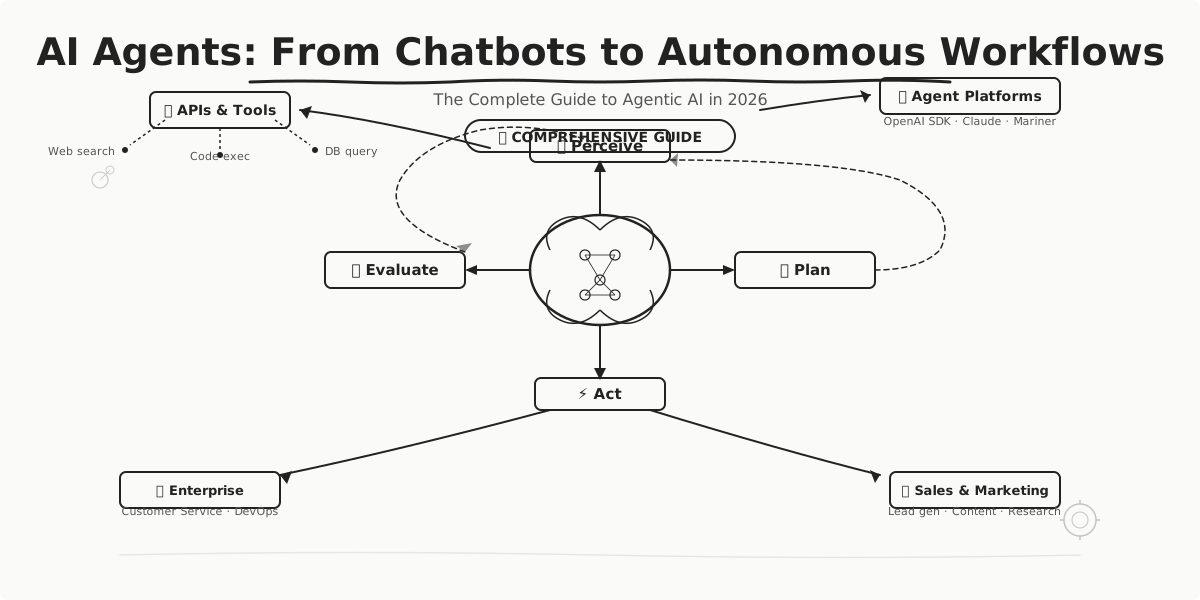
An AI agent is a software system that uses a large language model as its "brain" but extends far beyond simple Q&A. An agent can perceive its environment (through APIs, databases, sensors, or user input), set and prioritize goals, break those goals into sub-tasks, execute actions using tools and APIs, evaluate results, and adjust its approach based on feedback. This loop — perceive → plan → act → evaluate → repeat — is what distinguishes agents from chatbots.
Early versions of this concept appeared in 2024 with projects like AutoGPT and BabyAGI, which could chain together multiple LLM calls to accomplish simple tasks. The 2026 versions are dramatically more sophisticated. Modern AI agents use structured reasoning frameworks like ReAct (Reasoning + Acting) and Tree-of-Thought to plan their approach, maintain long-term memory across sessions, and leverage dozens of specialized tools.
The architecture typically includes several key components: a reasoning engine (the LLM), a planning module (for task decomposition), a memory system (short-term for conversation, long-term for learning), a tool library (APIs for web search, code execution, database queries, etc.), and an orchestration layer (for managing multi-agent systems).
The Leading AI Agent Platforms in 2026
OpenAI Agents SDK: The Accessible Entry Point
OpenAI's Agents SDK, launched in late 2025, has become the most accessible platform for building AI agents. It provides a simple Python framework for defining agent behaviors, connecting tools, and managing state. The SDK handles the complex orchestration logic — deciding when to call a tool, how to interpret results, and when to ask for human input — allowing developers to focus on agent logic rather than infrastructure.
Key features include guardrails (safety constraints that prevent agents from taking unauthorized actions), handoffs (seamless transfer between specialized sub-agents), and streaming responses that show the agent's thinking process in real-time. A customer support agent built with the SDK might automatically verify identity, check order status, initiate a refund, and escalate to a human — all in a single, auditable workflow.
Anthropic Claude Agent: Safety-First Autonomy
Anthropic's approach to AI agents emphasizes safety and transparency. Claude Agent uses Constitutional AI principles to ensure agents operate within defined ethical boundaries. Its tool-use capabilities are extensive — Claude can browse the web, execute code, analyze data, and even control desktop applications through computer use — but always with explicit permission gates for sensitive actions.
What sets Claude Agent apart is its exceptional instruction-following ability. In the GAIA benchmark (General AI Assistants), Claude Agent achieves the highest scores for complex multi-step tasks, making it the preferred choice for enterprise applications where reliability and predictability are paramount. Industries like finance, healthcare, and legal services have adopted Claude Agent for tasks ranging from contract analysis to regulatory compliance monitoring.
Google Project Mariner: The Browser-Native Agent
Google's Project Mariner represents a fundamentally different approach: an AI agent that lives inside the browser. Built on Gemini 3.0, Mariner can see and interact with web pages just like a human would — clicking buttons, filling forms, extracting data, and navigating between sites. For research, data collection, and web-based workflow automation, Mariner is unmatched.
A marketing researcher can ask Mariner to "find the top 20 competitors in the SaaS project management space, extract their pricing, feature sets, and founding dates, and compile everything into a spreadsheet" — and Mariner will methodically visit each site, extract the information, and deliver a structured result. The agent handles CAPTCHAs, login flows, and pagination automatically.
Real-World Enterprise Deployments
Customer Service Transformation
Customer service has been the most rapidly transformed domain. Leading companies in 2026 have deployed multi-agent systems where specialized agents handle different aspects of customer interaction. A tier-1 agent handles common inquiries (password resets, order status), a tier-2 agent handles complex issues (refunds, technical problems), and a triage agent intelligently routes between them and escalates to humans when necessary.
Telecom giant Swisscom reported a 65% reduction in human agent workload after deploying an AI agent system, while customer satisfaction scores increased by 12%. The key insight: agents handle the tedious, repetitive queries faster than humans, allowing human agents to focus on the complex, emotionally nuanced interactions where empathy matters.
Software Development and DevOps
AI agents have become indispensable in software development. GitHub Copilot's agent mode, launched in early 2026, can autonomously fix bugs, write tests, refactor code, and even create pull requests based on high-level descriptions. The agent understands the entire codebase, not just the file being edited, enabling context-aware changes across multiple files.
DevOps teams use agents for incident response. An agent monitoring production systems can detect an anomaly, investigate logs, identify the root cause, apply a fix (or rollback), and post an incident report — all within minutes. The human operator's role shifts from firefighting to supervising multiple autonomous incident response agents.
Sales and Marketing Automation
Sales teams have embraced AI agents for lead qualification and outreach. An agent can research a prospect's company, analyze their LinkedIn activity and recent news mentions, draft personalized outreach emails, schedule meetings, and update CRM records — all without human involvement until a meeting is confirmed.
Marketing teams deploy agents for competitive intelligence, content distribution, and campaign optimization. An agent monitors competitor announcements, summarizes key changes, drafts competitive response content, and distributes it across appropriate channels — turning a once-weekly manual process into a real-time automated workflow.
Challenges and Limitations
Despite remarkable progress, AI agents face significant challenges. Reliability remains the biggest concern — agents can hallucinate tool outputs, misunderstand instructions, or get stuck in loops. The industry standard for agent reliability in 2026 is around 85-90% for well-defined tasks, which is impressive but insufficient for mission-critical applications without human oversight.
Security is another major consideration. Agents with broad tool access pose risks if compromised or if they act on malicious instructions. The industry has responded with layered security — least-privilege tool access, human-in-the-loop approval for sensitive actions, continuous audit logging, and automated anomaly detection for agent behavior.
Cost can also be a barrier. Agentic workflows require multiple LLM calls per task, and complex operations can generate significant token usage. A single multi-step agent workflow might cost $0.50-5.00 in API calls, making it economical for high-value tasks but prohibitive for high-volume, low-value automation.
The Future: Multi-Agent Systems and Agent Economies
The cutting edge of agent technology in 2026 is multi-agent systems — teams of specialized agents that collaborate on complex tasks. A software development team might include a planning agent, a coding agent, a testing agent, a documentation agent, and a review agent, each specialized in their domain and communicating through a shared message bus.
This architecture mirrors human team structures and enables far more complex outcomes than any single agent could achieve. Early research from DeepMind shows that multi-agent systems can solve problems that are beyond the capability of individual agents, through emergent collaboration — agents teaching each other, correcting mistakes, and discovering novel solutions.
Looking ahead, the concept of "agent economies" — where AI agents negotiate, trade services, and collaborate across organizational boundaries — is the most speculative but potentially most transformative vision. A supply chain agent from Company A might automatically negotiate with a logistics agent from Company B to optimize delivery routes, everything handled by agents with human oversight of the outcomes rather than each transaction.
Conclusion: The Skills You Need for the Agent Era
The rise of AI agents doesn't mean humans become redundant — it means the skills that matter are changing. Prompt engineering is evolving into agent orchestration. The most valuable professionals in 2026 are those who can design agent workflows, define clear objectives and constraints, evaluate agent outputs critically, and handle the exceptions that agents cannot.
For businesses, the message is clear: AI agents are not a future trend. They are a present-day competitive advantage. Companies that have invested in agent infrastructure are seeing measurable returns in cost reduction, speed, and quality. Those that wait will find themselves competing against organizations that can do more work, with fewer people, in less time — and that's a competition that's hard to win.