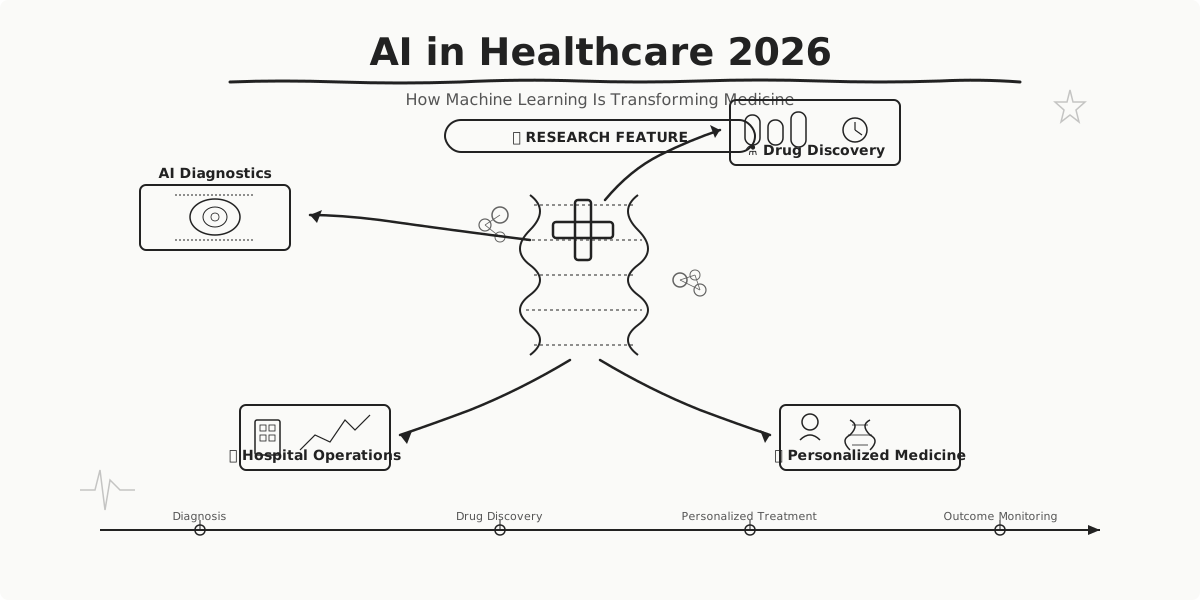
AI in Healthcare 2026: How Machine Learning Is Transforming Medicine
From drug discovery timelines compressed from years to months, to AI systems detecting cancer earlier than human radiologists, to personalized treatment plans tailored to individual genetic profiles — AI is reshaping healthcare in 2026. This article explores AI in drug discovery, diagnostics, personalized medicine, and hospital operations.
AI in Healthcare 2026: How Machine Learning Is Transforming Medicine
Every industry claims to be undergoing an AI revolution, but healthcare is different. In medicine, the stakes are literally life and death, the data is vast but fragmented, and the regulatory environment is among the most demanding in the world. Despite these challenges — or perhaps because of them — healthcare has emerged as one of the most impactful domains for artificial intelligence in 2026.
From drug discovery timelines compressed from years to months, to AI systems that can detect cancer earlier than human radiologists, to personalized treatment plans tailored to individual genetic profiles, AI is not just assisting healthcare — it is fundamentally reshaping what's possible in medicine. This article explores the key areas where AI is making the most significant impact in 2026.
"AI won't replace doctors. But doctors who use AI will replace those who don't. The question is no longer whether AI has a place in medicine, but how quickly we can integrate it safely and effectively." — Dr. Eric Topol, Professor of Digital Medicine at Scripps Research
AI in Drug Discovery: From Years to Months
The drug discovery pipeline has traditionally been one of the longest and most expensive processes in any industry. Developing a new drug typically takes 10-15 years and costs over $2 billion, with a 90% failure rate from first human trials to market approval. AI is transforming this landscape with breathtaking speed.
Structure Prediction and Molecular Design
DeepMind's AlphaFold, now in its third generation, has achieved near-perfect accuracy in predicting protein structures for essentially all known proteins — over 200 million structures in its database. But AlphaFold 3 goes further, predicting not just individual proteins but their interactions with other molecules, including potential drug compounds. This has turned what was once a years-long experimental process into a computational prediction that takes minutes.
Beyond structure prediction, AI systems like Isomorphic Labs (also from DeepMind) and Recursion Pharmaceuticals use generative AI to design novel drug candidates from scratch. Instead of screening millions of existing compounds to find a drug that might work, researchers can now describe the therapeutic goal — "design a molecule that binds to this protein and inhibits its function" — and have AI generate candidates optimized for efficacy, safety, and synthesizability.
Clinical Trial Optimization
AI is also revolutionizing clinical trials. Patient recruitment — traditionally one of the most time-consuming phases — is being transformed by AI systems that can scan electronic health records to identify eligible candidates in hours rather than months. AI models predict which patients are most likely to respond to a treatment, enabling smaller, faster, and more targeted trials.
Several major pharmaceutical companies, including Pfizer and Novartis, reported in early 2026 that AI-assisted drug discovery programs have reduced early-stage development timelines by an average of 60%. An AI-discovered drug candidate for a rare form of kidney disease entered clinical trials in just 18 months — a process that would typically take 5-7 years.
AI-Powered Diagnostics: Seeing the Unseen
Medical Imaging Revolution
AI's ability to analyze medical images has improved dramatically. In 2026, FDA-approved AI diagnostic tools cover radiology, pathology, dermatology, ophthalmology, and cardiology. These systems don't just match human performance — in many specific tasks, they exceed it.
Mammography screening with AI assistance has shown a 20% improvement in cancer detection rates with a 40% reduction in false positives, according to a landmark 2025 study published in The Lancet Digital Health. The AI doesn't replace the radiologist but serves as a second reader, flagging suspicious regions that the human might overlook and reducing the cognitive fatigue that leads to errors in high-volume screening programs.
In dermatology, AI systems can classify skin lesions with accuracy comparable to board-certified dermatologists, enabling primary care physicians to make more confident diagnoses and reducing unnecessary referrals. In ophthalmology, AI screening for diabetic retinopathy has become standard practice in several countries, allowing early intervention that prevents vision loss in thousands of patients annually.
Pathology and Laboratory Medicine
Digital pathology has been transformed by AI. Pathologists reviewing biopsy slides can now use AI to highlight abnormal cells, quantify biomarker expression, and even predict genetic mutations from tissue morphology alone. The AI can scan an entire slide in seconds and flag regions of interest, allowing pathologists to focus their expertise where it matters most.
In laboratory medicine, AI systems are being used to interpret complex test results, identify patterns that might indicate rare diseases, and flag potentially erroneous results before they reach clinicians. The result is faster, more accurate diagnoses and fewer medical errors.
A 2026 study from Johns Hopkins Medicine found that AI-assisted pathology reduced diagnostic turnaround times by 40% and improved concordance between pathologists by 15% — meaning patients get faster, more consistent diagnoses regardless of which pathologist reviews their case.
Personalized Medicine: Treatment Tailored to You
Perhaps the most exciting frontier is personalized medicine — treatments designed specifically for an individual's genetic makeup, lifestyle, and disease characteristics. AI is the key enabler of this vision.
Genomic Analysis at Scale
Whole genome sequencing has become affordable enough for routine clinical use, but interpreting the 3 billion base pairs of the human genome — and the millions of variants each person carries — is beyond human capability. AI models trained on millions of genomes can predict which genetic variants are pathogenic, estimate disease risk, and identify optimal treatment strategies based on a patient's unique genetic profile.
In oncology, AI-powered genomic analysis is now standard of care at leading cancer centers. A tumor's genome is sequenced, and AI identifies the specific mutations driving that cancer, then recommends targeted therapies matched to those mutations. What once took weeks of manual analysis by a team of geneticists now happens in hours.
Treatment Response Prediction
AI models can predict how individual patients will respond to different treatments based on their genetic profile, medical history, lifestyle factors, and even social determinants of health. A patient newly diagnosed with rheumatoid arthritis might have their blood tested, their genome sequenced, and their lifestyle analyzed — and receive a personalized prediction of which of the dozen available treatments is most likely to work for them, with the fewest side effects.
The impact on patient outcomes is significant. A 2026 multicenter study demonstrated that AI-guided treatment selection improved response rates by 35% in patients with autoimmune diseases, compared to standard trial-and-error approaches. Patients found the right treatment faster, experienced fewer side effects, and had better long-term outcomes.
AI in Hospital Operations and Administration
Beyond direct clinical applications, AI is transforming how hospitals operate. Predictive analytics models forecast patient admissions with remarkable accuracy, allowing hospitals to optimize staffing, bed allocation, and resource management. Emergency departments use AI to triage patients, predicting which patients are at risk of deterioration and need immediate attention.
Natural language processing systems automatically extract key information from clinical notes, reducing documentation burden for physicians — a major cause of burnout. AI scheduling systems optimize operating room utilization, reducing wait times for surgeries. Supply chain AI ensures that critical medications and equipment are always available while minimizing waste.
These operational improvements translate directly to patient care. Hospitals that have deployed comprehensive AI operations platforms report an average 15% reduction in patient wait times, 20% reduction in medication errors, and significantly improved staff satisfaction scores.
Challenges and the Path Forward
Despite remarkable progress, significant challenges remain. Data privacy and security are paramount concerns — healthcare data is among the most sensitive personal information. Regulatory frameworks are still catching up with the technology. In the United States, the FDA has approved over 1,000 AI-enabled medical devices as of 2026, but the approval process remains slower than the pace of innovation.
Bias in AI systems is a critical concern. Models trained predominantly on data from certain populations may perform poorly on others. Efforts to create more diverse, representative training datasets — and to audit AI systems for bias before deployment — have become standard practice in leading healthcare institutions.
Integration with existing healthcare IT systems remains challenging. Many hospitals still run on legacy electronic health record systems that weren't designed for AI integration. Interoperability standards are improving, but the gap between cutting-edge AI and the day-to-day reality of hospital IT infrastructure is still significant.
Conclusion: The AI-Augmented Healthcare System
The vision of AI in healthcare in 2026 is not one of robot doctors and fully automated hospitals. It is a more practical, more impactful vision: an AI-augmented healthcare system where technology handles the data-intensive, pattern-recognition tasks that humans do poorly and enables human clinicians to focus on what they do best — building relationships with patients, making complex ethical judgments, and providing compassionate care.
The numbers tell the story. AI-assisted drug discovery is bringing treatments to patients faster. AI-powered diagnostics are catching diseases earlier. Personalized medicine is ensuring patients get the right treatment the first time. And AI-optimized hospital operations are making healthcare more accessible and efficient.
For patients, the message is hopeful: the healthcare system of 2026 is smarter, faster, and more personalized than ever before. And the best is yet to come.