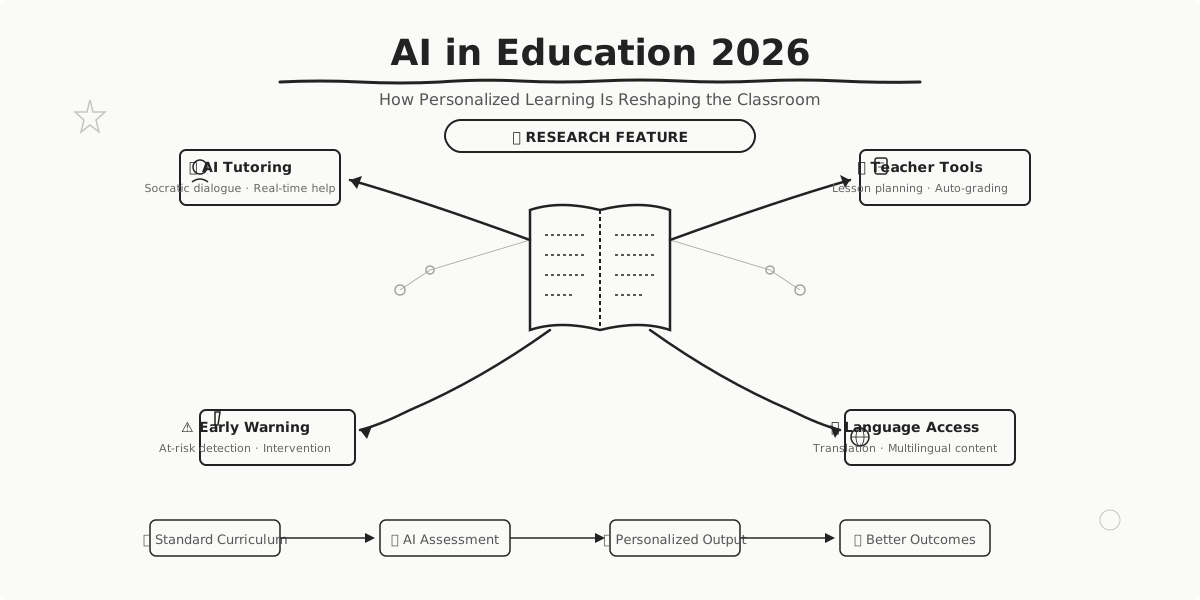
AI in Education 2026: How Personalized Learning Is Reshaping the Classroom
From AI tutors that adapt to every student's learning style, to early warning systems that detect at-risk students weeks before traditional methods, to AI-powered lesson planning that saves teachers 10+ hours per week — artificial intelligence is transforming education in 2026. This article explores how personalized learning is reshaping classrooms worldwide.
AI in Education 2026: How Personalized Learning Is Reshaping the Classroom
For decades, the model of education has remained fundamentally unchanged: a teacher standing in front of a classroom, delivering the same lesson to 30 students at the same pace, hoping that the middle of the bell curve will be well-served. The outliers — the gifted students who are bored and the struggling students who are lost — have been an accepted inefficiency of the system.
Artificial intelligence is dismantling this one-size-fits-all model. In 2026, AI-powered education platforms are not just supplementary tools; they are becoming the core infrastructure of personalized learning, available in classrooms, homes, and workplaces around the world. The shift from education as a broadcast medium to education as an adaptive conversation is arguably the most important transformation in learning since the printing press.
"The best teacher I ever had was an AI. Not because it knew more than my human teachers, but because it never got tired, never got frustrated, and it knew exactly how to explain things in a way that made sense to me." — High school student quoted in MIT Technology Review, 2026
Adaptive Learning Platforms: Teaching Every Student Individually
Adaptive learning technology has existed in primitive forms for over a decade — early platforms could adjust question difficulty based on right or wrong answers. But the 2026 generation of adaptive learning is radically different. Modern AI tutors don't just track which problems a student gets right or wrong; they build detailed cognitive models of how each student thinks.
These systems analyze not just the answer a student provides, but the path they took to get there. How long did they spend on each step? Did they try an approach and backtrack? What patterns of errors do they consistently make? By analyzing thousands of data points per student per session, AI tutoring systems can diagnose conceptual misunderstandings with precision that would take a human teacher hours of one-on-one assessment.
Products like Khan Academy's Khanmigo 3.0, Duolingo Max, and Carnegie Learning's MATHia have become the standard-bearers. Khanmigo 3.0, powered by GPT-5-level reasoning, doesn't just provide answers — it engages students in Socratic dialogue, asking probing questions that guide students toward discovery rather than simply delivering information. A student struggling with algebra might be guided through a real-world problem about splitting a restaurant bill, while an advanced student explores the same concept through calculating orbital mechanics for a space game.
Real-Time Intervention and Early Warning
Perhaps the most impactful application is early intervention. AI systems can detect when a student is falling behind long before traditional assessments would catch it. A student who normally completes math problems in 45 seconds and is suddenly taking 3 minutes, a student who has stopped asking questions in discussion forums, a student whose writing style shifts dramatically — these subtle signals, invisible to a teacher managing 150 students, are immediately flagged by AI monitoring systems.
School districts using AI early warning systems report an average 40% reduction in students needing remedial intervention. The AI flags at-risk students weeks or even months earlier than traditional methods, giving teachers and parents time to intervene while the gap is still small. In the Clarke County School District in Georgia, deployment of an AI early warning system in 2025 reduced the dropout rate by 18% in a single academic year.
AI-Powered Content Creation for Educators
Teachers spend an estimated 50% of their working hours on tasks other than direct instruction — lesson planning, grading, worksheet creation, report writing, and administrative paperwork. AI is dramatically reducing this burden, freeing teachers to focus on what they do best: building relationships with students.
AI lesson plan generators can take a curriculum standard — "teach the causes of World War I at an 8th-grade reading level" — and produce a complete lesson plan including reading materials, discussion questions, group activities, assessment rubrics, and differentiated versions for struggling and advanced students. The resulting plans are not generic templates; they incorporate the teacher's preferred teaching style, the class's performance history, and even local cultural context.
Grading has been transformed by AI as well. While AI still struggles with nuanced subjective assessments, the grunt work of grading — multiple-choice quizzes, fill-in-the-blank exercises, short-answer factual questions — has been almost entirely automated. Teachers report saving 8-12 hours per week on grading alone, time they redirect to one-on-one student support and lesson improvement.
Breaking Language Barriers in Education
Language remains one of the biggest barriers to educational access worldwide. Over 40% of the world's population does not have access to education in their native language. AI-powered real-time translation and multilingual content generation are changing this.
In immigrant-heavy school districts, AI translation tools enable teachers to communicate with non-English-speaking parents, translate homework assignments, and provide bilingual instruction materials. A single teacher can now effectively teach a classroom with students speaking five different home languages, with AI providing real-time translation of both written materials and spoken instruction.
Perhaps more importantly, AI enables students to learn in their native language while acquiring proficiency in a second language. A Spanish-speaking student in a US classroom can receive math instruction in Spanish while the same AI system simultaneously helps them build English vocabulary through contextual exposure. Bilingual education, long considered a luxury of well-funded districts, is becoming accessible to every school.
AI in Higher Education and Vocational Training
Universities are deploying AI for far more than administrative efficiency. AI-powered research assistants help graduate students navigate the exploding volume of academic publications — an AI trained on a student's research area can summarize relevant papers, identify gaps in the literature, and even suggest novel research hypotheses.
In medical education, AI-powered simulation platforms allow students to practice diagnoses and procedures on virtual patients that respond realistically to their decisions. These AI patients have detailed medical histories, exhibit realistic symptoms, and even display emotional responses. A medical student can see thousands of cases in simulation before ever treating a real patient, dramatically accelerating clinical competence.
Vocational training has seen equally significant transformations. AI-powered training simulations for welders, mechanics, electricians, and construction workers provide realistic practice environments where mistakes cost nothing. An apprentice electrician can practice wiring a complex circuit board dozens of times in VR with AI guidance, each time receiving specific feedback on technique and safety.
Challenges: Screen Time, Equity, and the Teacher's Role
The integration of AI in education is not without significant challenges. Screen time concerns have intensified as education becomes increasingly digital. Pediatric organizations recommend limits on screen time for young children, creating tension with AI-powered learning platforms that require sustained screen engagement. The industry is responding with voice-based interfaces, physical-digital hybrid activities, and scheduled offline reflection periods.
The digital divide remains a critical issue. Students without reliable internet access or devices are being left further behind as AI-enhanced education becomes the norm. Programs distributing subsidized devices and offline-capable AI learning platforms are expanding, but the gap remains one of the most pressing equity challenges in education technology.
Perhaps the most fundamental question is the changing role of teachers. As AI takes over content delivery, assessment, and administrative tasks, what is left for human teachers? The emerging consensus is that the teacher's role shifts from "sage on the stage" to "guide on the side" — facilitating discussions, providing emotional support, fostering creativity and critical thinking, and building the human connections that are the foundation of effective education. Technology handles the transmission of information; humans handle the transformation of information into wisdom.
Conclusion: The Hybrid Classroom
The classroom of 2026 is not a fully automated, teacherless environment. It is a hybrid space where AI handles personalization, assessment, and content delivery at scale, while human teachers focus on mentorship, emotional support, and the higher-order thinking skills that machines cannot replicate. Students who need extra help get it immediately, advanced students are continuously challenged, and teachers have more time to do the work that brought them into the profession in the first place.
The early results are promising. Students in AI-augmented classrooms show an average 30% improvement in standardized test scores compared to traditional classrooms, with the largest gains among students from disadvantaged backgrounds. The gap between the highest and lowest performers narrows by 22% — suggesting that AI's greatest impact may be in leveling the educational playing field.
Education has always been about preparing students for the future. In 2026, that future includes AI as a learning partner. The schools that embrace this partnership — thoughtfully, equitably, and with the human element at the center — will be the ones that best prepare their students for a world that is changing faster than ever before.