AI in Cybersecurity: How Machine Learning Is Defending Against Next-Gen Threats
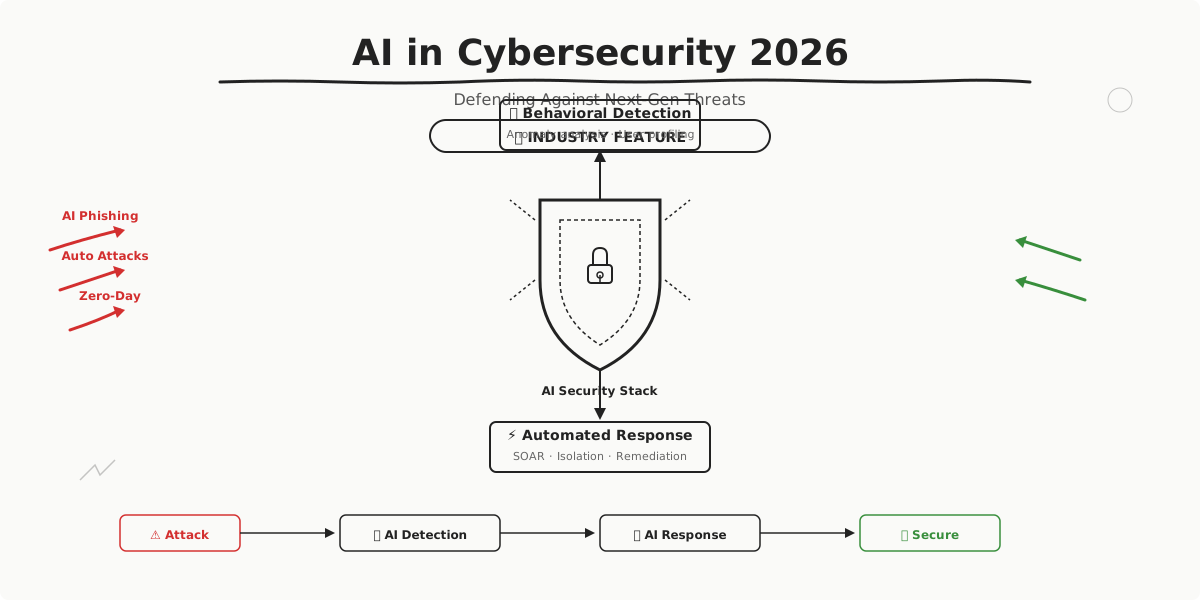
AI-powered cyber attacks — from personalized phishing to autonomous attack agents — are the most dangerous threats facing organizations in 2026. But AI-powered defense is fighting back with behavioral detection, automated incident response, and predictive threat intelligence. This article explores the AI security landscape from both sides of the battle.
AI in Cybersecurity: How Machine Learning Is Defending Against Next-Gen Threats
The cybersecurity landscape has undergone a fundamental transformation. For years, the battle between attackers and defenders was a reactive arms race — attackers discovered a vulnerability, defenders patched it, attackers found the next one. But the emergence of AI-powered cyber threats has changed the rules of engagement entirely. Attackers now use AI to automate reconnaissance, generate convincing phishing emails at scale, discover zero-day vulnerabilities, and adapt their tactics in real-time to evade detection.
The good news is that defenders have access to the same technology. In 2026, AI is not just a tool in the cybersecurity arsenal — it is the foundation of modern cyber defense. This article explores how machine learning is being deployed across the cybersecurity landscape, from endpoint protection to threat intelligence to automated incident response, and examines the emerging challenges of defending against AI-powered adversaries.
"AI-powered cyber attacks are like a chess grandmaster playing against a human. The human might win a game here or there through luck or creativity, but over time, the machine's ability to calculate every possibility and adapt instantly is overwhelming. Defenders must use AI to fight AI." — Lisa Chen, CISO of Palo Alto Networks
The New Threat Landscape: AI-Powered Attacks
Understanding how AI is being used defensively requires first understanding how attackers have adopted the technology. AI-powered cyber attacks in 2026 are qualitatively different from their predecessors in several key ways.
Intelligent Phishing and Social Engineering
Traditional phishing attacks relied on generic, mass-emailed lures — the infamous "Nigerian prince" emails that were obvious to most recipients. AI-generated phishing is terrifyingly sophisticated. Using large language models trained on a target's public social media posts, professional profiles, and even past email breaches, AI can craft highly personalized messages that mimic the writing style of a trusted colleague or executive.
A 2026 study by Darktrace found that AI-generated phishing emails have a success rate of 35% compared to 5% for traditional phishing — a sevenfold increase. These attacks reference recent events in the target's life, use appropriate emotional triggers, and are free of the grammatical errors that traditionally tipped off vigilant users. Voice deepfakes have added a new dimension: attackers can now call employees using a perfect AI-generated replica of their CEO's voice, requesting urgent wire transfers or credential access.
Autonomous Attack Agents
The most concerning development is the emergence of autonomous attack agents — AI systems that can independently probe networks, identify vulnerabilities, exploit them, establish persistence, and exfiltrate data without human direction. These agents operate 24/7, learn from failed attempts, and can coordinate distributed attacks across thousands of targets simultaneously.
Unlike human attackers, AI agents never get tired, never lose focus, and can execute complex multi-stage attacks faster than any human team. A single autonomous agent can scan an entire organization's external footprint, identify the weakest entry point, launch a targeted exploit, and pivot laterally through the network — all in the time it takes a human penetration testing team to complete their initial reconnaissance.
AI-Powered Defense: Fighting Fire with Fire
Behavioral Detection and Anomaly Analysis
Traditional signature-based security systems — which rely on databases of known malware signatures — are nearly useless against AI-powered attacks that can generate novel variants faster than signature databases can be updated. Modern AI defense systems use behavioral detection, building models of what "normal" looks like for every user, device, and application in an organization.
CrowdStrike's Charlotte AI and SentinelOne's Purple AI exemplify this approach. These systems establish baseline behavior profiles — a specific employee typically accesses these files from this location between these hours using this device — and flag deviations regardless of whether the specific attack technique has ever been seen before. An attacker who compromises a legitimate user account will trigger alerts not because their malware is known, but because their behavior is anomalous.
The speed advantage is dramatic. Traditional security operations centers (SOCs) take an average of 200 days to detect a sophisticated breach. AI-powered detection systems reduce this to minutes or even seconds. In controlled tests, Microsoft's Security Copilot identified and contained a simulated advanced persistent threat in 47 seconds — a process that would have taken a human team 3-6 hours.
Automated Incident Response
The most significant operational impact of AI in cybersecurity is automated incident response. In the past, when an alert was triggered, a human analyst would investigate, determine the severity, decide on a response, and execute remediation actions. This process could take hours — time during which an attacker could cause enormous damage.
AI-powered SOAR (Security Orchestration, Automation, and Response) platforms now handle the entire incident response lifecycle for common threat types. When a potential breach is detected, the AI automatically isolates the affected device, blocks the attacker's IP, initiates forensic data collection, alerts the incident response team with a detailed analysis, and even begins remediation — all within seconds.
For high-severity incidents, the AI still involves human analysts, but provides them with comprehensive situational context — what happened, what systems were affected, what data may have been compromised, and recommended response actions. The human's role shifts from detective and firefighter to decision-maker and overseer.
AI in Threat Intelligence and Prediction
Threat intelligence has been transformed by AI's ability to process enormous volumes of data from disparate sources. An AI threat intelligence system ingests data from open-source intelligence feeds, dark web monitoring, industry threat-sharing groups, internal telemetry, and government alerts — and synthesizes this data into actionable intelligence.
Perhaps the most valuable capability is predictive threat intelligence. By analyzing patterns in attacker behavior, infrastructure, and targeting, AI systems can predict which organizations are likely to be targeted next, what attack methods will be used, and which vulnerabilities are most likely to be exploited. This allows organizations to proactively harden their defenses before an attack occurs, rather than reacting after the fact.
Google's Mandiant AI demonstrated this capability during the 2025 Log4Shell variant outbreak, correctly predicting the specific industry sectors that would be targeted 72 hours before the first attacks were detected in those industries — giving affected organizations critical preparation time.
Zero Trust and AI-Driven Access Control
Zero Trust architecture — the principle of "never trust, always verify" — has become the dominant security paradigm in 2026. AI is the engine that makes Zero Trust practical at scale. AI-driven identity and access management systems continuously evaluate user risk scores based on behavior, device posture, network context, and threat intelligence.
A system might determine that an employee logging in from their usual device at their usual location has a low risk score and grant access normally. But if that same employee suddenly attempts to access sensitive financial data at 3 AM from an unfamiliar IP address, the AI dynamically increases authentication requirements — prompting for multi-factor authentication, requiring manager approval, or blocking the request entirely.
This dynamic, context-aware approach is far more effective than static role-based access controls. Organizations using AI-driven Zero Trust report 60% fewer successful credential-based attacks and a 40% reduction in insider threat incidents.
The Challenges: Adversarial AI and False Positives
AI-powered defense is not without its vulnerabilities. Adversarial machine learning — techniques that fool AI models by feeding them carefully crafted inputs — is an emerging threat. Attackers can subtly modify malware to evade AI detection, or craft inputs that cause the AI to misclassify malicious activity as benign.
The AI security research community is responding with more robust models, adversarial training, and ensemble detection approaches that combine multiple AI models to reduce the impact of any single model being compromised. But the cat-and-mouse game at the AI level mirrors the traditional cybersecurity arms race.
False positives remain a challenge. AI systems that are too sensitive generate alert fatigue, overwhelming security teams with non-threatening events. Systems tuned for lower sensitivity miss real threats. The best implementations use confidence scoring, tiered alerting, and continuous feedback loops — when a human analyst marks an alert as a false positive, the AI learns from that correction and adjusts future behavior.
Conclusion: The AI Security Stack
In 2026, AI is not an optional enhancement to cybersecurity — it is a fundamental requirement. Organizations that deploy AI-powered detection, automated response, predictive intelligence, and dynamic access control are dramatically more secure than those relying on traditional methods. The economics are compelling: AI-driven security operations cost 40-60% less than equivalent human-staffed SOCs while providing superior detection and response times.
For security professionals, the message is clear: the future of cybersecurity is AI-augmented, not AI-replaced. The most effective security teams in 2026 are those that combine human judgment, creativity, and ethical reasoning with AI's speed, scale, and pattern recognition. The threats are evolving faster than ever, but the tools to defend against them have never been more powerful.