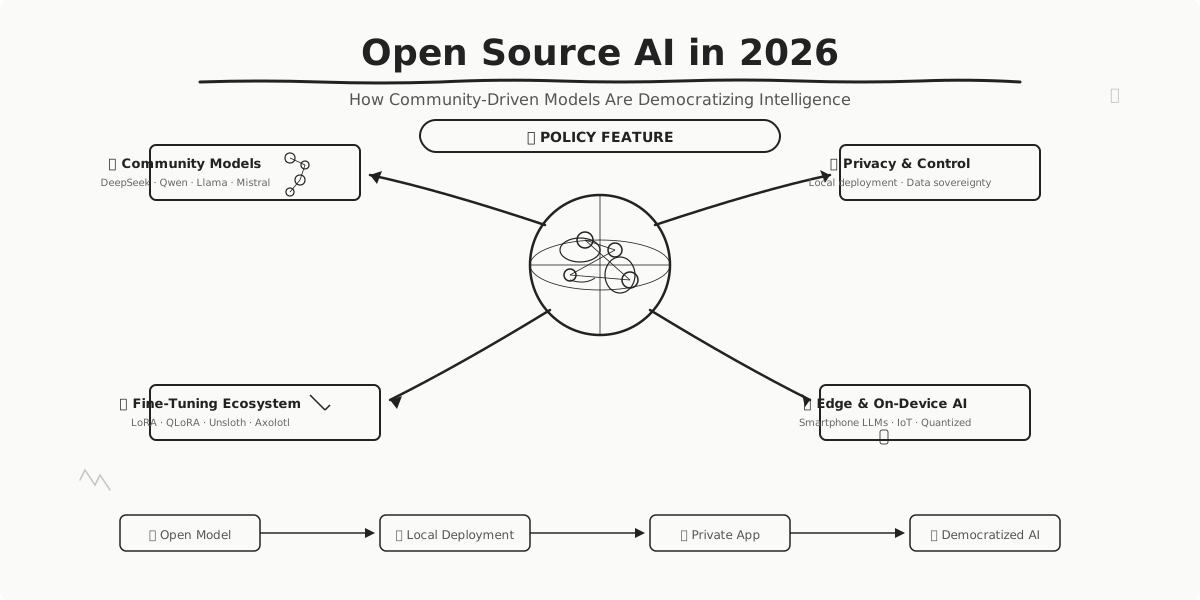
Open Source AI in 2026: How Community-Driven Models Are Democratizing Intelligence
From Meta's Llama to DeepSeek to thousands of community-built models, open source AI has matured from a fringe movement into a force that rivals proprietary alternatives. In 2026, anyone with a computer can run state-of-the-art AI locally. This is the story of how open source AI went from underdog to indispensable.
Open Source AI in 2026: How Community-Driven Models Are Democratizing Intelligence
In early 2024, the AI landscape was dominated by a small number of proprietary models — GPT-4, Claude, Gemini — controlled by a handful of Silicon Valley companies. Access to cutting-edge AI required API keys, credit cards, and acceptance of corporate terms of service. The technology that promised to democratize intelligence was itself becoming concentrated in fewer and fewer hands.
Two years later, the picture has changed dramatically. The open source AI movement has matured from a fringe rebellion into a formidable force that rivals — and in some areas surpasses — proprietary alternatives. In 2026, anyone with a reasonably powerful computer can run state-of-the-art language models, image generators, and even video creation tools locally, without sending a single piece of data to a corporate server. This is the story of how open source AI went from underdog to indispensable.
"Proprietary AI is like renting a car. Open source AI is like owning one. You can modify it, take it anywhere, and you don't need to ask for permission. In 2026, more and more organizations are choosing to own." — Yann LeCun, Chief AI Scientist at Meta
The Open Source Revolution: How We Got Here
The turning point was Meta's release of Llama 2 in July 2023. While not truly open source by strict definitions, Llama 2's relatively permissive license sparked an explosion of community innovation. Developers fine-tuned it, quantized it, built tools around it, and pushed its capabilities far beyond what Meta originally delivered. The genie was out of the bottle.
By 2024, the community had produced models like Mistral, Mixtral, Qwen, DeepSeek, and Yi — each pushing the frontier of what was possible with open weights and permissive licenses. The release of Llama 3 and Llama 4 further accelerated the trend, with Meta's latest models approaching GPT-4-class performance while being freely available.
In 2025, the open source ecosystem achieved a critical milestone: for the first time, the gap between the best open model and the best proprietary model narrowed to less than 5% on most standard benchmarks. For many practical applications — code generation, content writing, customer support, data analysis — open models had achieved parity. The only remaining advantages of proprietary models were in extreme long-context tasks, cutting-edge multimodal capabilities, and the convenience of managed APIs.
2026 has cemented this trend. Models like DeepSeek-V4, Qwen 3.5, and the community-developed Falcon 3 are not just competitive — in specific domains like mathematical reasoning and multilingual understanding, they outperform their proprietary counterparts. The open source ecosystem now encompasses not just language models, but image generation (Stable Diffusion 4, FLUX.1), speech recognition (Whisper 5), video generation (open-source variants of Sora-like architectures), and specialized models for code, science, medicine, and law.
Why Open Source AI Matters
Privacy and Data Sovereignty
The most compelling argument for open source AI is privacy. When an organization uses a proprietary AI API, every prompt, every piece of data, every business secret is sent to a third-party server. Even with promises of data isolation, many organizations — particularly in healthcare, finance, law, and government — cannot legally or ethically send sensitive data to external AI services.
Open source models that run entirely on local hardware eliminate this concern. A hospital can deploy an LLM internally to analyze patient records without any data leaving its network. A law firm can use AI to review confidential documents without risking exposure. A government agency can leverage AI for classified work without worrying about foreign data access laws. For these organizations, open source AI is not a nice-to-have — it is the only viable option.
Customization and Fine-Tuning
Proprietary AI models are black boxes. You can prompt them, but you cannot change how they think. Open source models, by contrast, can be fine-tuned on domain-specific data, adapted to understand industry jargon, and optimized for specific tasks. A legal AI assistant fine-tuned on 50,000 legal documents will outperform a general-purpose proprietary model on legal tasks, even if the proprietary model is larger and more capable overall.
The fine-tuning ecosystem has become remarkably accessible. Tools like Unsloth, Axolotl, and Hugging Face's AutoTrain allow developers with modest GPU resources to fine-tune state-of-the-art models in hours. LoRA (Low-Rank Adaptation) and QLoRA reduce the computational requirements to the point where a single consumer GPU can produce a useful fine-tuned model. In 2026, thousands of specialized models are being created every week — for medical diagnosis, financial analysis, customer support, game NPC dialogue, and countless other domains.
Cost and Independence
The economics of open source AI are compelling. Running a medium-sized open model (7-13 billion parameters) on rented GPU hardware costs roughly $0.50-2.00 per hour. For an organization processing millions of queries per day, this is dramatically cheaper than paying per-token API fees, which can run into hundreds of thousands of dollars annually at scale.
Beyond cost, there is the question of independence. Organizations that build their AI infrastructure around proprietary APIs are locked into a single vendor. Pricing changes, API deprecations, policy shifts, or service outages can cripple a business overnight. Open source AI provides sovereignty — the ability to control your own AI destiny, including the ability to switch providers, run models on-premises, or preserve capabilities indefinitely even if a vendor disappears.
The Open Source Ecosystem in 2026
Model Hubs and Registries
Hugging Face has become the GitHub of AI, hosting over 2 million models and 500,000 datasets as of mid-2026. The platform provides not just storage and discovery, but inference APIs, training infrastructure, community benchmarking, and model governance tools. A developer can find a model, evaluate its performance on relevant benchmarks, fine-tune it on custom data, and deploy it to production — all within the Hugging Face ecosystem.
The emergence of model registries with governance features has addressed one of the early criticisms of open source AI — the lack of curation and quality control. Organizations like the Open Source AI Alliance and the Model Safety Institute provide certification programs that verify model provenance, safety testing, and license compliance.
Edge and On-Device AI
The most exciting frontier is on-device AI. Models optimized for smartphones, laptops, and IoT devices have become remarkably capable. Apple's on-device models, Google's Gemini Nano, and the open-source MobileLLM can handle sophisticated language tasks entirely on-device, with no network connection required. A student in a remote village with no internet access can run a capable AI tutor on their phone. A field worker can use AI-powered translation in areas with no cellular coverage.
Quantization techniques — reducing model precision from 16-bit to 4-bit or even 2-bit — have made it possible to run models with billions of parameters on devices with as little as 4GB of RAM. The Phi-3.5 and Gemma 3 models achieve remarkable performance at sizes that fit entirely on a modern smartphone.
Challenges: Safety, Misuse, and Sustainability
Open source AI is not without significant challenges. The most pressing concern is safety and misuse. Open models can be downloaded, modified, and deployed by anyone — including malicious actors who remove safety guardrails and use the models to generate misinformation, develop weapons, or automate cyber attacks. Unlike proprietary APIs, there is no central point of control to enforce responsible use.
The AI safety community is responding with several approaches. Watermarking and provenance techniques make it possible to identify AI-generated content even from modified open models. Safety evaluation frameworks like the MLCommons AI Safety Benchmark provide standardized testing. And responsible licensing — including the "RAIL" licenses that restrict use for certain harmful applications — is becoming more common in the open source AI world.
Sustainability is another concern. Training large open source models requires enormous computational resources. The carbon footprint of training a single 70-billion-parameter model can exceed the lifetime emissions of several cars. The community is responding with more efficient architectures, training techniques that require less data and compute, and a growing emphasis on smaller, more efficient models that achieve competitive performance with a fraction of the resource requirements.
Conclusion: The Open Future
The trajectory is clear. Open source AI is not a niche alternative to proprietary models — it is the future of how AI will be deployed in the real world. Proprietary models will continue to push the frontier of what's possible, but the practical work of applying AI to real problems — in healthcare, education, business, and government — will increasingly be done with open models that organizations can control, customize, and trust.
For developers and organizations evaluating their AI strategy in 2026, the advice is straightforward: start with open source. Test whether a fine-tuned open model can meet your needs before committing to proprietary APIs. The open ecosystem has matured to the point where, for the vast majority of practical applications, the answer will be yes — and you'll gain privacy, control, and cost savings in the process.
The democratization of AI was always the promise of the technology. In 2026, thanks to the open source community, that promise is becoming a reality.