AI in Finance 2026: How Machine Learning Is Transforming Banking, Trading, and Risk Management
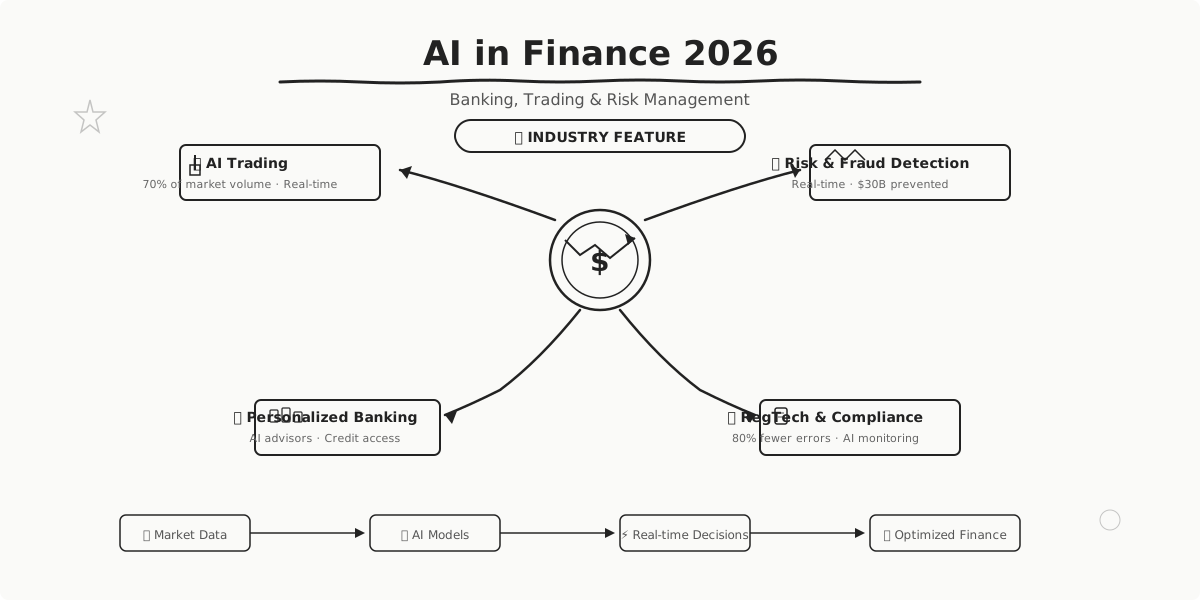
From AI trading algorithms that execute 70% of market volume to fraud prevention systems saving $30 billion annually, artificial intelligence is transforming every corner of finance in 2026. This article explores AI in trading, risk management, personalized banking, and the challenges of bias and systemic risk.
AI in Finance 2026: How Machine Learning Is Transforming Banking, Trading, and Risk Management
The financial industry has always been driven by information — who has it first, who can process it fastest, and who can make the best decisions with it. In 2026, artificial intelligence has become the dominant force in every corner of finance, from the high-frequency trading algorithms that execute millions of trades per second to the AI-powered chatbots that handle 80% of customer service inquiries at major banks.
The transformation has been remarkably rapid. Just five years ago, AI in finance was largely experimental — used by a few quantitative hedge funds and forward-thinking banks. Today, it is the core infrastructure of the global financial system. This article explores the key areas where AI is making the most significant impact: algorithmic trading, risk management, fraud detection, personalized banking, and credit assessment.
"Banking used to be about relationships. Then it became about data. Now it's about algorithms. The banks that win in 2026 are the ones that have the best AI models — not the biggest branch networks or the largest marketing budgets." — Jamie Dimon, Chairman and CEO of JPMorgan Chase
AI in Algorithmic Trading: Speed and Intelligence
Algorithmic trading is not new — computers have been executing trades based on predefined rules for decades. But AI-powered trading represents a quantum leap in capability. Modern AI trading systems don't just execute rules; they discover patterns, learn from market behavior, and adapt strategies in real-time.
Deep Learning for Market Prediction
The most sophisticated trading firms now use deep learning models that analyze thousands of data streams simultaneously — price movements, news sentiment, social media trends, satellite imagery of retail parking lots, shipping data, and macroeconomic indicators. These models identify non-obvious correlations that human traders would never spot. For example, a model might detect that increased shipping traffic through a specific port correlates with a rise in certain commodity prices three days later, and execute trades based on that insight.
Renaissance Technologies, the legendary hedge fund, has publicly stated that over 90% of its trading decisions in 2026 are made by AI models with minimal human intervention. The firm's Medallion Fund has averaged annual returns of 66% over the past five years — a performance record that no human-run fund has come close to matching.
Natural Language Processing for News Analysis
AI systems now process every earnings call transcript, regulatory filing, news article, and social media post relevant to publicly traded companies — in real-time, in hundreds of languages. When a CEO says "we're cautiously optimistic" during an earnings call, the AI doesn't just detect the sentiment; it compares the phrasing to thousands of historical calls, models the probability of different outcomes, and can execute trades based on that analysis within milliseconds of the words being spoken.
A 2026 study by the Bank for International Settlements estimated that AI-driven trading accounts for approximately 70% of all trading volume in major equity markets, up from 40% in 2022. This shift has raised concerns about market stability — AI trading systems have been implicated in several "flash crash" events where correlated algorithms amplified market moves — but regulators have struggled to keep pace with the technology.
AI in Risk Management and Fraud Detection
Risk management has been transformed by AI's ability to model complex, non-linear relationships that traditional statistical models cannot capture. Banks use AI to model portfolio risk under thousands of hypothetical scenarios, including "black swan" events that have never occurred before. These models can simulate the impact of simultaneous shocks — a pandemic, a cyber attack, a geopolitical crisis, and an interest rate spike — and calculate the probability of portfolio losses with remarkable accuracy.
Real-Time Fraud Detection
Credit card fraud detection has been one of the most visible AI success stories. AI models analyze every transaction in real-time, evaluating hundreds of risk factors — location, time, purchase amount, device fingerprint, typing speed, and historical behavior patterns — and decide whether to approve, flag, or block the transaction in under 100 milliseconds.
Modern systems have driven fraud rates to historic lows. Visa reports that its AI-powered fraud detection system, VAA (Visa Advanced Authorization), prevents approximately $30 billion in annual fraud losses, with a false positive rate below 0.1%. The system learns continuously — when a legitimate transaction is initially flagged but the customer confirms it, the model updates its understanding of that customer's behavior for future transactions.
Money laundering detection has seen similar advances. AI systems analyze transaction networks to identify suspicious patterns that would be invisible to rule-based detection systems. A traditional system might flag a single large transfer; an AI system can detect a coordinated money laundering scheme involving hundreds of small transactions across dozens of accounts, connected by subtle patterns in timing, amounts, and counterparty relationships.
Personalized Banking and Customer Experience
Retail banking has been transformed by AI-powered personalization. The one-size-fits-all banking experience — the same savings account, the same credit card, the same investment advice for everyone — has been replaced by hyper-personalized financial products tailored to individual needs and behaviors.
AI Financial Advisors
Robo-advisors have evolved far beyond simple portfolio allocation algorithms. Modern AI financial advisors — like Wealthfront's AI Advisor and Betterment's Smart Deposit — build comprehensive financial models of each user, including income patterns, spending habits, risk tolerance, life goals, and even psychological biases. The AI continuously monitors the user's financial health, automatically optimizing savings, investments, and debt management.
JPMorgan Chase's AI-powered financial health platform, launched in 2025, reduced the average overdraft rate among its users by 45% within the first year, saving customers an estimated $200 million in fees. The AI predicts when a customer is at risk of overdrawing their account and proactively suggests transfers, payment timing adjustments, or short-term credit options.
AI in Credit Assessment
Traditional credit scoring — based primarily on credit history, income, and debt-to-income ratio — systematically excludes the 1.7 billion adults worldwide who have no credit history. AI-powered alternative credit assessment models use hundreds of data points — utility payment history, rent payments, educational background, employment stability, and even smartphone usage patterns — to build creditworthiness profiles for previously "unscorable" individuals.
Lending startups like Tala and Branch have used AI-based credit assessment to extend over $10 billion in loans to underserved populations in developing markets, with default rates lower than traditional lenders serving comparable customers. In 2026, major banks have begun adopting similar approaches, expanding credit access to millions of consumers who were previously locked out of the formal financial system.
Regulatory Compliance and "RegTech"
Financial regulation has become exponentially more complex since the 2008 financial crisis. Banks now spend an estimated $270 billion annually on compliance — roughly 10% of their operating costs. AI-powered regulatory technology — "RegTech" — is dramatically reducing this burden.
AI systems can monitor every transaction, communication, and internal process for regulatory compliance in real-time. When a new regulation is published, AI models analyze its requirements, map them to existing processes, identify gaps, and generate compliance documentation — a process that once required teams of lawyers and compliance officers working for months.
The European Central Bank reported in early 2026 that AI-assisted compliance systems reduced regulatory reporting errors by 80% and cut compliance costs by an average of 35% across the banks it supervises. The technology is so effective that several central banks have begun requiring AI compliance systems for systemic financial institutions.
Challenges: Bias, Transparency, and Systemic Risk
The rapid adoption of AI in finance has raised serious concerns. Algorithmic bias is a critical issue — AI models trained on historical lending data can perpetuate and amplify existing discriminatory patterns. A 2025 study by the Consumer Financial Protection Bureau found that some AI-based lending models were 25% more likely to deny loans to minority applicants than to white applicants with identical financial profiles.
Transparency is another challenge. Many of the most effective AI models — particularly deep learning systems — are "black boxes" whose decision-making processes are opaque even to their creators. When an AI trading system loses $100 million in a flash crash, or an AI lending model denies credit to a qualified applicant, explaining why is essential for both regulatory compliance and public trust. The field of "explainable AI" has become one of the most active research areas in financial technology.
Systemic risk remains the most concerning issue. When hundreds of financial institutions use similar AI models trained on similar data, correlated behavior can amplify market movements in dangerous ways. Regulators are exploring the concept of "AI circuit breakers" — automatic trading pauses triggered when AI-driven activity reaches certain thresholds — and mandatory model diversity requirements for systemically important financial institutions.
Conclusion: The AI-Powered Financial System
The financial system of 2026 is fundamentally AI-powered — from the algorithms that move trillions of dollars through global markets to the chatbots that help customers manage their personal finances. The transformation has brought enormous benefits: faster, cheaper, and more accessible financial services; dramatically improved fraud detection; and credit access for millions who were previously excluded.
But the challenges are equally significant. Bias, opacity, and systemic risk are not bugs that can be patched — they are fundamental challenges that require ongoing attention from technologists, regulators, and society as a whole. The financial system of the future will be shaped not just by what AI can do, but by how responsibly we deploy it.