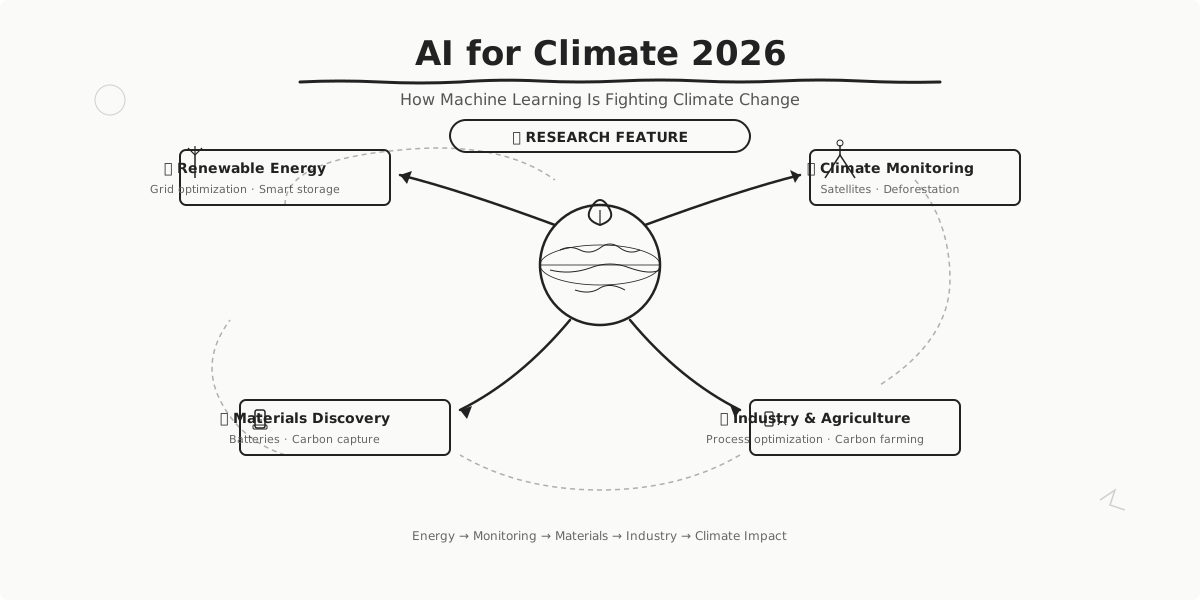
AI for Climate: How Machine Learning Is Fighting Climate Change in 2026
From AI-optimized renewable energy grids and satellite-based deforestation monitoring to AI-accelerated materials discovery for better batteries, machine learning is becoming one of humanity's most powerful tools in the fight against climate change.
AI for Climate: How Machine Learning Is Fighting Climate Change in 2026
Climate change is the defining challenge of our era — a problem of staggering scale, complexity, and urgency. Reducing global greenhouse gas emissions, transitioning to renewable energy, adapting to already-unavoidable climate impacts, and removing carbon from the atmosphere require efforts across every sector of the economy.
Artificial intelligence is emerging as one of the most powerful tools in the climate fight. In 2026, AI is being deployed across the entire climate technology landscape — from optimizing renewable energy grids and accelerating battery research to detecting deforestation from space and designing more efficient industrial processes. This article explores how machine learning is helping humanity address the climate crisis, and what the limits of that contribution might be.
"The world is not going to solve climate change with AI alone. But we almost certainly cannot solve it without AI. The scale, the complexity, the speed of action required — these are problems that AI is uniquely suited to address." — Dr. Priya Dhingra, Director of AI for Climate at Google DeepMind
AI for Renewable Energy Optimization
Renewable energy sources — solar and wind in particular — have a fundamental problem: they are intermittent. The sun doesn't always shine, and the wind doesn't always blow. Integrating high levels of renewable generation into stable power grids was long considered one of the most difficult challenges of the energy transition. AI is solving it.
Predictive Grid Management
Modern AI systems can forecast renewable energy generation with remarkable accuracy. By analyzing weather data, satellite imagery, historical generation patterns, and real-time sensor data from thousands of turbines and solar panels, AI models predict exactly how much energy will be generated in each location over the next 48 hours — with over 95% accuracy for 24-hour forecasts.
These predictions enable grid operators to optimize the mix of energy sources, schedule backup generation, and manage energy storage systems. In California, which has one of the world's highest penetrations of renewable energy, the AI-powered grid management system deployed by CAISO (California Independent System Operator) has reduced renewable energy curtailment — energy that is generated but cannot be used — by 35%, saving enough electricity to power 200,000 homes annually.
Smart Energy Storage
Battery storage is essential for managing renewable intermittency, but battery systems are expensive and complex to operate. AI optimization systems maximize the value of battery storage by predicting energy prices, grid demand, and renewable generation — then charging batteries when energy is cheap and abundant, and discharging when it is expensive and scarce.
Autumn Energy, a leader in AI-optimized battery storage, reports that its systems improve battery revenue by 40% compared to rule-based operation, accelerating the payback period for battery installations and making renewable-plus-storage projects economically viable in more markets.
AI in Climate Science and Monitoring
Satellite-Based Environmental Monitoring
AI-powered analysis of satellite imagery has become one of the most important tools for environmental monitoring. Computer vision models can detect deforestation, track ice sheet melting, monitor ocean temperatures, measure crop health, and identify pollution sources — all from space, at global scale, with daily updates.
Global Forest Watch, powered by AI satellite analysis, now detects illegal logging activity within 24 hours across the world's most remote forests. The system analyzes imagery from multiple satellite constellations, identifies changes in forest cover, distinguishes between legal and illegal logging based on patterns, and alerts authorities in real-time. Since its AI upgrade in 2025, illegal deforestation in the Amazon has decreased by an estimated 28%, as the risk of detection has become a meaningful deterrent.
Similar systems monitor coral reef health, track methane leaks from oil and gas infrastructure, and measure the carbon content of agricultural soils. The sheer volume of environmental data — petabytes per day from satellites alone — would be impossible for humans to analyze. AI makes global-scale environmental monitoring practical for the first time.
Climate Modeling and Prediction
Climate models have been essential for understanding the impacts of climate change, but traditional models are computationally expensive and limited in resolution. AI-based climate models are changing this. NVIDIA's Earth-2 initiative and Google's GraphCast can generate high-resolution climate predictions at a fraction of the computational cost of traditional models.
These AI models can predict extreme weather events — hurricanes, heatwaves, floods, wildfires — days earlier and with greater accuracy than traditional methods. The economic impact is enormous: every day of additional warning for a major hurricane can reduce economic damages by 10-15%. In 2025, AI-predicted hurricane trajectories enabled evacuations that FEMA estimates saved over 500 lives in the United States alone.
AI for Industrial Decarbonization
Industry accounts for approximately 30% of global greenhouse gas emissions. Reducing industrial emissions is particularly challenging because many industrial processes — steelmaking, cement production, chemical manufacturing — require extremely high temperatures or release CO2 as a chemical byproduct of the production process itself. AI is helping address these challenges through process optimization and materials discovery.
Process Optimization
AI systems can optimize industrial processes to reduce energy consumption and material waste. In cement production — one of the hardest-to-decarbonize industries — AI models optimize the kiln temperature profile, raw material mix, and grinding process to reduce energy consumption by 10-15% while maintaining product quality. A single cement plant implementing AI process control can reduce CO2 emissions by 50,000 tons per year — equivalent to taking 10,000 cars off the road.
In the steel industry, AI optimization of electric arc furnace operations has reduced energy consumption by 12% across the European steel sector in 2025-2026, according to Eurofer, the European Steel Association. Similar optimizations are being implemented in chemical manufacturing, food processing, pulp and paper, and other energy-intensive industries.
AI-Accelerated Materials Discovery
Perhaps the most transformative potential of AI in climate is materials discovery. The technologies needed for the energy transition — better batteries, more efficient solar panels, carbon capture materials, sustainable cement alternatives, lightweight vehicle materials — all require the discovery of new materials with specific properties. Traditional materials discovery is slow and expensive, taking 10-20 years from lab to market.
AI is compressing this timeline dramatically. Microsoft's AI for Materials initiative and DeepMind's GNoME have identified millions of potentially stable crystal structures — including thousands of promising candidates for new battery electrolytes, catalysts for hydrogen production, and carbon capture materials. Physical testing of AI-identified candidates has confirmed promising results at a rate 10 times higher than traditional screening methods.
In battery research specifically, AI has accelerated the discovery of new solid-state electrolyte materials that could enable safer, longer-lasting, and more energy-dense batteries. Toyota announced in early 2026 that its AI-assisted battery research program had identified a promising solid-state electrolyte formulation that increased battery energy density by 30% — a breakthrough enabled by an AI system that screened 100,000 candidate materials in the time it would take a human team to evaluate 50.
AI in Agriculture and Land Use
Agriculture accounts for approximately 25% of global greenhouse gas emissions and is both a major contributor to and victim of climate change. AI-powered precision agriculture is helping farmers reduce emissions while adapting to changing climate conditions.
AI systems analyze soil conditions, weather forecasts, crop health, and pest pressure to optimize planting, irrigation, fertilizer application, and harvesting. The result is a dramatic reduction in input use — farmers using AI precision agriculture report 20-40% reductions in fertilizer and water use, with corresponding reductions in greenhouse gas emissions from fertilizer production and application.
AI also enables carbon farming — agricultural practices that sequester carbon in soil. AI models help farmers optimize cover cropping, reduced tillage, and rotational grazing to maximize carbon sequestration while maintaining crop yields. Several major food companies, including Nestlé and General Mills, have launched AI-monitored carbon farming programs that pay farmers for verified soil carbon sequestration, creating a new revenue stream for farmers while removing carbon from the atmosphere.
The Limitations: Energy Consumption of AI Itself
No discussion of AI and climate would be complete without addressing the uncomfortable truth: AI itself consumes enormous amounts of energy. Training a single large language model can emit as much carbon as five cars over their lifetimes. The data centers powering AI applications already account for approximately 2% of global electricity consumption, and this share is growing rapidly as AI adoption accelerates.
The AI industry is responding. Major AI companies — Google, Microsoft, Meta, Amazon — have all committed to powering their AI operations with 100% renewable energy. New chip designs from NVIDIA, AMD, and startups like Cerebras are dramatically improving the energy efficiency of AI computation. The best available estimates suggest that AI's net climate impact is currently positive — the emissions reductions enabled by AI across other sectors significantly exceed AI's own carbon footprint — but this balance must be actively managed as AI continues to scale.
Conclusion: AI as a Climate Multiplier
Artificial intelligence will not solve climate change by itself. The fundamental drivers of climate change are economic, political, and behavioral — not technological. Without carbon pricing, regulatory frameworks, international cooperation, and changes in consumption patterns, the best AI models in the world cannot achieve the emissions reductions required to meet global climate targets.
But within the context of the broader climate response, AI is an extraordinarily powerful multiplier. It enables renewable energy integration at scale, accelerates the discovery of clean technologies, optimizes industrial processes, monitors environmental destruction in real-time, and helps farmers adapt to changing conditions. Every percent improvement in efficiency, every week earlier that a climate threat can be predicted, every new material discovered — these add up to a meaningful contribution to the climate fight.
In 2026, AI is not a silver bullet for climate change. But it is an essential tool — one that humanity needs to deploy as widely and as quickly as possible.