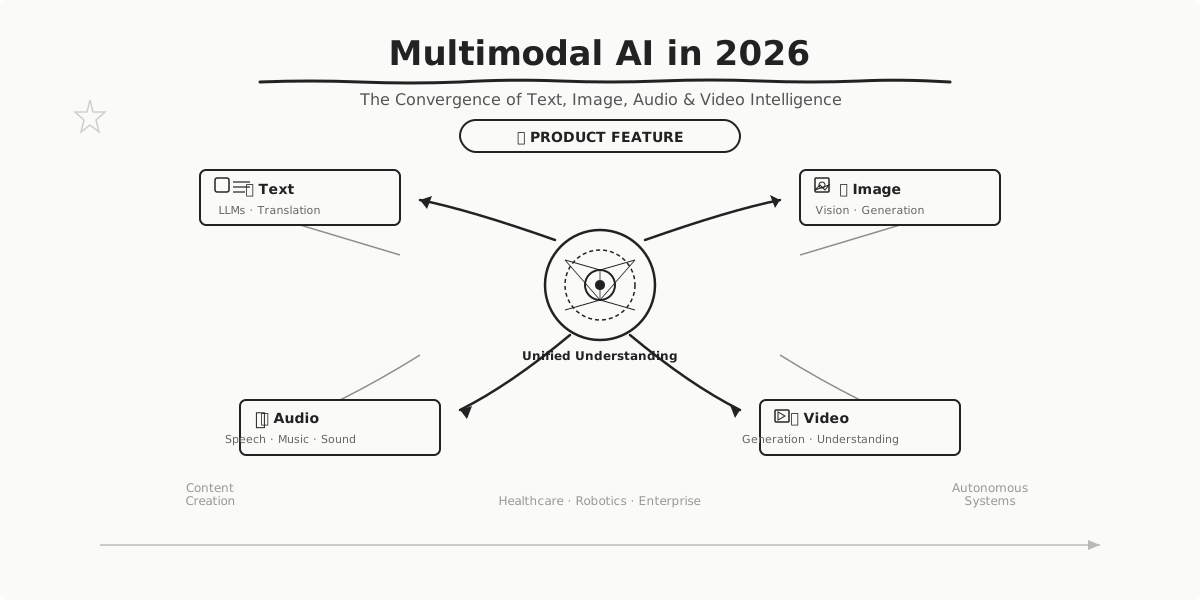
Multimodal AI in 2026: The Convergence of Text, Image, Audio, and Video Intelligence
In 2026, the distinction between language models, image models, and video models is disappearing. Truly multimodal AI — systems that understand and generate across text, image, audio, and video simultaneously — represents one of the most significant advances since the transformer architecture itself.
Multimodal AI in 2026: The Convergence of Text, Image, Audio, and Video Intelligence
For most of the history of artificial intelligence, models were specialists. Language models understood text. Computer vision models understood images. Speech models understood audio. Video models understood moving images. These models lived in separate worlds, trained on separate data, optimized for separate tasks. To build a system that could, say, look at a photograph, listen to a description of it, read the caption, and generate a video summary — you would have needed to stitch together half a dozen different models with fragile integration layers.
In 2026, this is no longer the case. The emergence of truly multimodal AI models — systems that understand and generate across text, image, audio, and video simultaneously — represents one of the most significant advances in artificial intelligence since the transformer architecture itself. This article explores what multimodal AI is, the leading models, their applications, and why this convergence matters more than incremental improvements in any single modality.
"Human intelligence is inherently multimodal. We don't think in text, or images, or sounds — we think in all of them at once. The fact that AI is finally becoming multimodal isn't just a technical improvement. It's the difference between a system that processes information and one that understands it." — Dr. Fei-Fei Li, Co-Director of Stanford's Human-Centered AI Institute
What Is Multimodal AI?
A multimodal AI model is a single neural network that can process and generate multiple types of data — typically text, images, audio, and video — using a shared representation space. Unlike earlier approaches that combined separate models for each modality, modern multimodal models learn a unified understanding of the relationships between different data types.
The key architectural innovation is the ability to map different modalities into a shared embedding space. A word like "sunset," an image of a sunset, the sound of waves at sunset, and a video of the sun setting over the ocean are all mapped to nearby points in this shared space, even though the raw data looks completely different. This allows the model to understand that a textual description of a scene, an image of that scene, and a video of that scene are referring to the same thing.
The leading multimodal models in 2026 include OpenAI's GPT-5 (which natively handles text, images, and audio), Google's Gemini 3.0 Pro (which adds video understanding to the mix), Anthropic's Claude 4 (which emphasizes safety across modalities), and Meta's Llama 4 (the most capable open-source multimodal model). Each of these models can accept input in any combination of modalities and generate output in any combination — a user can show a photo, ask a question about it in text, and receive a spoken audio response.
Applications Transforming Industries
Content Creation and Creative Tools
Multimodal AI has become the foundation of next-generation creative tools. A filmmaker can describe a scene in natural language, show reference images, hum a melody for the soundtrack, and have the AI generate a complete storyboard with synchronized audio — all within a single interface powered by a single model.
Adobe's Firefly 4, built on a multimodal foundation, allows designers to combine text prompts, reference images, audio clips, and video examples in any combination. A designer can upload a brand logo, type "create a 30-second commercial in the style of this video," hum a tune for the background music, and receive a complete commercial draft. The model understands the relationship between the visual style of the reference video, the emotional tone of the melody, and the brand identity of the logo — producing coherent, professional results.
Music production has been particularly transformed. Multimodal AI tools can now generate music that matches the emotional tone of a video, aligns with the rhythm of visual cuts, and adapts to the narrative arc of a story. A video editor can upload a rough cut, describe the desired mood — "tense and atmospheric for the first 30 seconds, building to triumphant" — and the AI generates a custom soundtrack that syncs perfectly with the visual timeline.
Healthcare: A Natural Multimodal Domain
Healthcare is perhaps the most natural application for multimodal AI. A doctor diagnosing a patient naturally integrates multiple types of information — the patient's spoken symptoms, visual examination findings, medical images (X-rays, MRIs, CT scans), laboratory test results, and the patient's written medical history. Each of these is a different modality, and integrating them is essential for accurate diagnosis.
Multimodal AI systems in 2026 can perform this integration at a superhuman level. A system like Google's Med-PaLM 3 can simultaneously analyze a patient's radiology images, lab results, genomic data, clinical notes, and even real-time speech patterns during the consultation — producing a unified diagnostic assessment that considers all available evidence. In clinical trials, multimodal AI diagnostic systems have outperformed single-modality systems by 25% and matched or exceeded specialist-level accuracy across multiple diagnostic domains.
The impact is particularly significant for rare diseases, where diagnosis often requires connecting subtle clues across multiple types of data. A patient might have a distinctive facial appearance visible in photographs, specific patterns in blood test results, and particular findings on genetic sequencing — each clue by itself is too subtle to trigger an alert, but together they form a recognizable pattern that a multimodal AI can identify. Early detection of rare diseases through multimodal AI has reduced diagnostic delays by an average of 18 months, dramatically improving patient outcomes.
Autonomous Systems and Robotics
Autonomous vehicles were one of the earliest testbeds for multimodal AI, combining camera data, LiDAR, radar, GPS, and map data. In 2026, multimodal AI has become the standard architecture for all autonomous systems — from self-driving cars to warehouse robots to drones.
A warehouse robot doesn't just see its environment through cameras; it also processes audio cues (a warning beep from another robot), reads text instructions (the label on a package), understands spoken commands from human workers, and integrates all of these inputs into a unified understanding of its task. Multimodal AI is what allows these systems to operate safely and effectively in complex, dynamic environments.
Robotics companies like Boston Dynamics and Tesla have reported that multimodal AI systems reduce task failure rates by 40-60% compared to single-modality approaches, because the model can fall back on alternative sensory inputs when one modality is unreliable — using sound to supplement vision in a dark warehouse, for example, or using speech to clarify ambiguous visual instructions.
The Technical Breakthroughs Behind Multimodal AI
Several technical innovations have made truly multimodal AI possible. The first is the development of large-scale multimodal training datasets — collections of data that pair text with images, audio with video, and all combinations in between. Datasets like LAION-5B (5 billion image-text pairs) and YouTube-8M (millions of labeled video segments) provide the training foundation for multimodal models.
The second is architectural innovations that enable efficient multimodal fusion. Techniques like cross-attention allow the model to dynamically determine which information from which modality is most relevant at each step. When processing a video with audio and subtitles, the model can learn to focus on audio during an explosion scene, visual information during a quiet dialogue, and text during a caption-heavy segment — dynamically shifting attention between modalities as appropriate.
The third is the dramatic improvement in tokenization for non-text modalities. Modern multimodal models can encode images, audio, and video into compact token sequences that can be processed by the same transformer architecture used for text. A 4K image can be represented as a few thousand tokens — dramatically fewer than earlier approaches that required tens of thousands — enabling efficient processing while preserving high fidelity.
Challenges: Hallucination Across Modalities
Multimodal AI inherits and amplifies many of the challenges of single-modality models. Hallucination — the tendency of AI models to generate confident but incorrect information — becomes more complex when it spans multiple modalities. A multimodal model might generate a video that looks realistic but depicts physically impossible events, or produce an image that is beautiful but contains text with significant factual errors.
Safety becomes more challenging when models can generate across multiple modalities simultaneously. A text-only model can generate harmful content, but a multimodal model can generate a photorealistic image of a person who doesn't exist saying things they never said, with a synchronized audio track that mimics their voice. The potential for misuse is qualitatively different from any single-modality technology.
Training data requirements are another challenge. Multimodal models require not just large datasets, but datasets where the same concepts are represented across multiple modalities — a specific person, place, or event depicted in text, images, audio, and video. These datasets are much harder to create than single-modality datasets, and concerns about copyright and consent are amplified when multiple modalities are involved.
Conclusion: The Unification of AI
The rise of multimodal AI represents a fundamental shift in how we think about artificial intelligence. For the first time, AI systems can perceive and interact with the world in something approaching the way humans do — integrating information from multiple senses, understanding relationships between different types of data, and communicating across the full richness of human expression.
In 2026, the distinction between "language models," "image models," and "video models" is rapidly becoming outdated. The future of AI is not a collection of specialized tools, but unified multimodal systems that understand the world in all its complexity. The implications span every industry — from healthcare and education to entertainment and scientific research — and the technology is still in its early stages. As multimodal models continue to improve, the boundary between what AI can understand and what humans can express will continue to blur.